Trump’s El Salvador deportations have “reshaped the calculus” for those tempted to cross border, federal court in San Francisco hears
The Trump administration’s aggressive approach to deporting foreign criminals — including by sending them to third-party countries such as El Salvador — has “reshaped the calculus” among prospective illegal aliens considering coming to the United States, a federal court heard today.
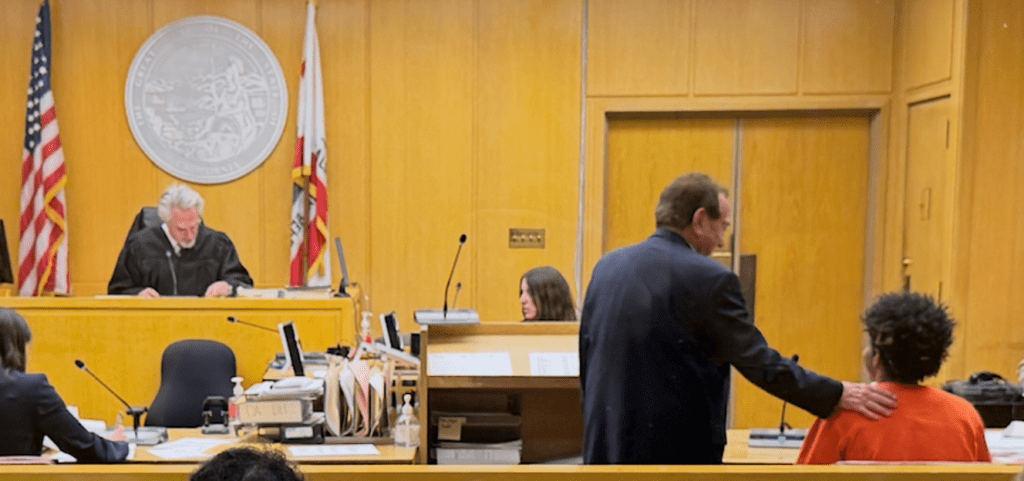
The claim was made as Honduran Brayan Lopez-Cruz was sentenced to three years’ imprisonment after he was caught dealing fentanyl months after being released by a trusting San Francisco judge.
Although the foreign national was on felony probation when he was caught in the city’s Tenderloin with substantial quantities of drugs and more than $1,000 in cash, Superior Court Judge Brian Stretch turned a blind eye to his record and promptly released him on his own recognizance in May 2024.
The four-time deportee, perhaps unsurprisingly, went straight back to selling fentanyl and he was arrested again selling drugs in San Francisco in September 2024. Federal prosecutors then acted.
“I think what concerns me is that fact that he was released in superior court on his own recognizance and then he continued to sell drugs and the drug that he selling is fentanyl,” said U.S. District Judge Charles Breyer this morning.
Today in courtroom six of San Francisco federal courthouse, Lopez-Cruz’ attorney, public defender Angela Chuang, prayed-in-aid the administration’s tough stance against illegal aliens to support a lower sentence for her client. Chuang’s office represents virtually all of the Honduran dealers who are prosecuted by the federal government.
“Deportation…means something different now than it did before,” she wrote in a sentencing memorandum filed last week.
“Immigration consequences have become all the more salient and severe in recent months under the Trump administration.”
Chuang was endeavoring to persuade the judge that this state of affairs mean that Lopez-Cruz could this time be trusted not to reenter the U.S. again and so a longer prison term was unnecessary.
“There has been a sea change in the federal government’s immigration policies and how they are conducting deportations, which have profoundly impacted migrants’ decisions to enter the country unlawfully,” she added.
“[D]eportations now involve the very real possibility that one will instead be sent to spend an indeterminate amount of time in horrific conditions in prisons in authoritarian third countries such as El Salvador with no access to due process and little regard for basic human rights.”
“[T]he risks and consequences associated with illegal entry into the U.S. have increased exponentially, and have reshaped the calculus for those who would consider doing so.”
“Mr Lopez-Cruz has no desire whatsoever to put himself in a position where he could be deported to notoriously inhumane prisons in El Salvador or elsewhere with no legal recourse”
Accordingly, said Chuang, Lopez-Cruz would not return to the U.S. and a fifteen month sentence would suffice.
He earlier pleaded guilty to two counts of possession with intent to distribute.
How much this represents an accurate prediction of criminals’ future choices, as opposed to being an artful attempt to spare a single client some additional prison time, is an open question.
The court was told that Lopez-Cruz — in common with many other Honduran drug dealers — has been in the country so long he now has two U.S.-born children. As the law currently stands, they are regarded as U.S. citizens and may in future provide a route for him to return to the country legally. He also has two children in Honduras who, the court heard, he has not seen for five years.
Remittances sent to Honduras amounted to more than $9 billion in 2023 according to World Bank data — representing a threefold growth in just over a decade.
This amounts to one quarter of the gross domestic product of the entire nation. More than 90% of this money comes from individuals present in the United States. Precisely how much of it comes from the trafficking of illegal narcotics is unclear.
The court was told that Lopez-Cruz had been deported to Honduras in 2016, 2017 and twice in 2018 – in most cases after being apprehended at the border or shortly after crossing into the United States.
Since returning again, and arriving the Bay Area, he has been untroubled by immigration authorities.
In 2020 he was caught selling drugs just blocks from San Francisco’s federal courthouse after which a judge at the city’s Hall of Justice gave him diversion “In other words,” wrote assistant U.S. attorney Nikhil Bhagat, “he suffered nary a consequence.”
Over the next few years he also clocked up arrests in Sonoma and Alameda for drugs and gun possession, always returning to San Francisco’s Tenderloin.
“This suggests to me that maybe the judges aren’t doing the right thing — somebody’s not doing the right thing.”
U.S. District Judge Charles Breyer on the approach of his state counterparts
“I’m really very sorry,” said Lopez-Cruz this morning through a Spanish-language interpreter. “I regret having done it. I will never do it again. And I will not come back to this country.”
Judge Charles Breyer handed down a three year prison term.
Breyer dismissed an attempt by Lopez-Cruz’ attorney to argue that her client’s conduct was little different from that other defendants who are given generous ‘time served’ sentences as part of federal authorities ‘fast track’ program after they too ignored court orders to stop dealing drugs.
“This suggests to me that maybe the judges aren’t doing the right thing — somebody’s not doing the right thing,” he said of his state counterparts at the city’s Hall of Justice.
“There’s no evidence that he appreciates the consequences of his conduct,” said the judge of the defendant.
The federal prosecution represented something of a reverse for Lopez-Cruz. California courts carefully protect illegal aliens accused of further crimes and his immigration status had been studiously overlooked in his state cases. San Francisco Mayor Daniel Lurie has reaffirmed his commitment to the city’s sanctuary laws and refused to countenance deporting foreign felons.
Lopez-Cruz had been arrested for dealing fentanyl, methamphetamine and other drugs on April 22 2024 in San Francisco’s Tenderloin district. Just over two weeks later Superior Court Judge Brian Stretch ordered that the four-time deported, gun-possessing illegal alien drug dealer be released.
“Obey all laws” and “appear in court as ordered” suggested the judge optimistically on the release form. Instead Lopez-Cruz went back to peddling fentanyl in the Tenderloin where he was arrested again.


Please support our work by using this Paypal link
To be notified of new stories enter your email address here or follow us on X