Courtroom rethink needed after Norteño sentencing disorder
The roving brawl between family members and supporters of both a defendant and one of his victims last week, causing chaos inside and outside the courthouse, came after a series of misjudgments which ratcheted up tensions between the groups and what appeared to be insufficient manpower available to quell the conflict.
It culminated in the Assistant U.S. Attorney prosecuting the cases, Leif Dautch, leaving the court, wading into the melee, and himself helping extract an involved family member before their actions progressed to a point beyond which a blind eye could be turned.
Fernando Madrigal – who murdered Day’von Hann and Luis Garcia – was the first of three Norteño murderers to be dealt with on Thursday afternoon. Beforehand, however, the court held two other sentencing hearings, each for defendants who had successfully completed a ‘convictions alternative program’ – a scheme for certain lower-level offenders which helps them avoid a custodial sentence.
These are typically, and were here, happy occasions where the judge hears about the hard work and application of the defendant from defense attorneys, government attorneys and a probation official.
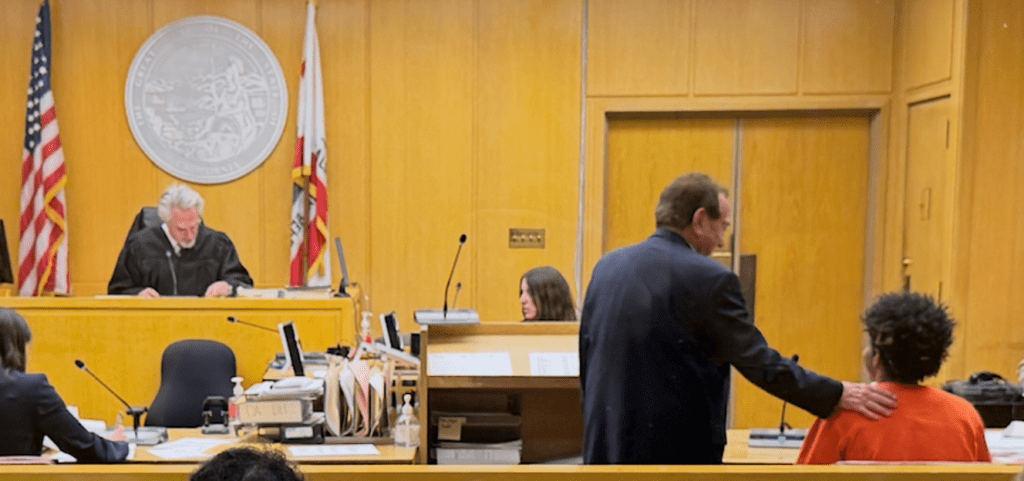
So for nigh on 40 minutes families of murder victims and families of those about to receive swingeing sentences were left to stew, separated by a few feet, in court number two of San Francisco federal courthouse.
They listened to a lawyer for the first CAP participant proudly tell the judge that she would shortly be seeing her children for the first time in a long while. Given that, over the next three hours, the court would go on to hear from heartbroken mothers who lamented that they would never see their children again, this was an incongruous moment.
They were then required to hear jovial references to a poem written by the second defendant and which was previously read to fellow participants in the convictions alternatives program.
Neither of these hearings was inappropriate in themselves. When set against the gravity of the hearings to follow, tensions inevitably rising, and the babies and children accompanying family members growing more restless, the thoughtlessness of the choice to hold them at the same time was difficult to credit.
And, having made the determination to hold them at all, it seemed that the decision about holding the pair of CAP hearings first may have been made on the hoof, as Fernando Madrigal was initially brought in to court by U.S. Marshals before the judge arrived, only to be removed again shortly thereafter.
In the cold light of day U.S. District Judge William Orrick will surely feel he was poorly advised to allow the calendaring of the RICO sentences with the more mundane and less significant proceedings.
It detracted from the judge’s otherwise capable oversight of the three Norteño hearings themselves and his considerate handling of bereaved family members who spoke – some of whom were so overcome with grief that they could barely be understood through their tears.

Additional support for hard-pressed court security officers would have been beneficial. Officers on duty acquitted themselves with great professionalism, and in particular dealt with both sides beforehand with a well-judged combination of courtesy and authority. Ultimately there were too few of them.
The layout of San Francisco Federal Courthouse can’t be helped but didn’t help. Located on the 17th floor of the federal building at 450 Golden Gate Avenue, courtroom 2 is served by an elevator bank that also services other floors in the building. This caused the ugly face-off between the family and supporters of both Madrigal and Day’von Hann to continue as elevators were repeatedly called – and it was hardly a surprise when the disorder (“a large fight”) resumed outside of the building.
If a review isn’t already underway, one should be put in train immediately, allowing court authorities to satisfy themselves that all is as it should be with respect to handling of similar cases in future. Packed courtrooms, consequential hearings, and family members enduring the most difficult of circumstances, would benefit from dedicated hearing times and places, a bias toward too many security staff rather than too few, and care taken to ensure attendees leave before darkness falls outside.
To be notified when new stories are published, please enter your email address below or follow us on X / Twitter.