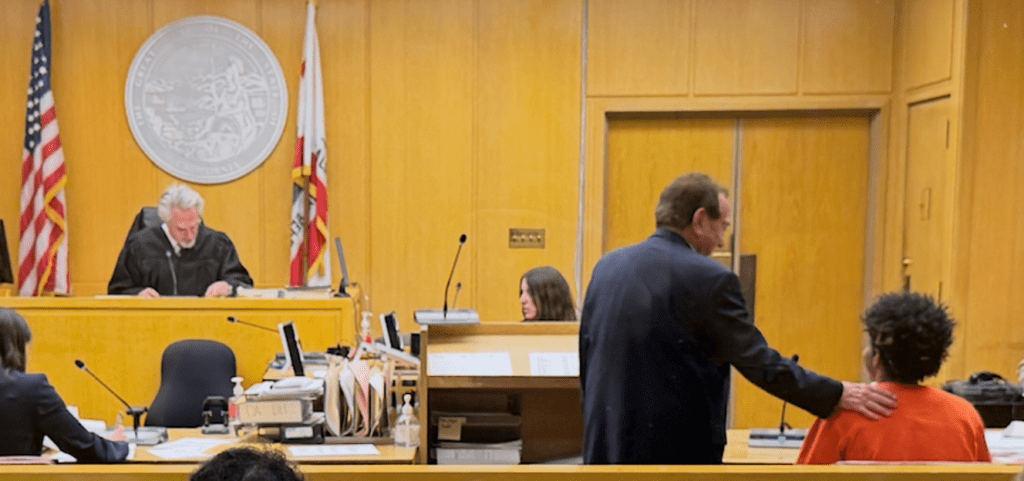
‘Life without parole’ killer of San Francisco boy denied release at first parole hearing
A man sentenced to ‘life without parole’ for the 1996 torture and murder of a San Francisco boy was denied parole this afternoon after becoming eligible when prosecutors successfully petitioned a judge to resentence him to a lower term.
Edward Kennedy brutally assaulted 5’1”, 100-pound Sergio Crockett, to force him to reveal where he kept a stash of drugs.
The 15 year old boy was stabbed, stripped and tied up in Kennedy’s Outer Sunset home.
After reassuring him he was being driven to the hospital, and as Sergio pleaded for his life, Kennedy “wailed” on the child, inflicting another 44 stab wounds, before dumping his body on the street at 12th and Anza and ditching the knife in a Golden Gate Park lake.
He was convicted of first-degree murder with special circumstances and sentenced to life without parole.
He was resentenced in 2022 thanks to the efforts of a cadre of public defenders brought to the prosecutor’s office by former district attorney Chesa Boudin.
Earlier this month his successor Brooke Jenkins branded Kennedy’s resentencing a “travesty” that should never have happened.
“I stabbed him to death because I was on the crack and smoking crack makes me evil, that’s why.”
Edward Kennedy
“I stabbed him to death because I was on the crack and smoking crack makes me evil, that’s why,” said Kennedy today when asked to explain why he killed Sergio.
San Francisco Public Defender’s Office, which represents Kennedy, failed in a last-ditch bid to have our reporter, the only observer present, thrown out of the hearing at its outset.
“I do not believe it is a mainstream publication,” deputy public defender Jared Rudolph told commissioners of San Francisco Public Safety News, also complaining that there was no transparency over the organization’s funding.
“Your objection is noted and overruled,” responded presiding commissioner Michael Ruff shortly.
Kennedy appeared at the hearing by videoconference from High Desert State Prison clad in a blue prison outfit and a white helmet which he wore, he said, because he was prone to seizures.
“I stabbed him to death because I was on the crack and smoking crack makes me evil, that’s why,” he said when asked to explain why he murdered Sergio. “I wanted his dope, I wanted his money and the only way I could get it was to act evil. As long as I’m not acting evil I’m alright.”
“One of the main reasons that I killed Sergio is that there would be no witnesses…[to] robbing him and stabbing him, ” he subsequently said.

“Given his diminished mental capacity it’s not surprising that he was unable to answer many of the commissioners’ questions today,” said Rudolph on Kennedy’s behalf.
“I assert that he lacks the capacity to petition for his parole because he cannot remember basic biographical facts about his life, he cannot provide insight into the factors underlying the murder of Sergio Crockett. Because he cannot follow the thread of the commissioners’ inquiries, he cannot respond effectively.”
Rudolph went on to outline the various ailments from which Kennedy suffers and told commissioners that it was poor value for California taxpayers to keep paying for his “extraordinarily expensive’ healthcare while incarcerated. He noted that his client had recently been taken on a $90,000 helicopter flight to a medical facility in Nevada to address a health concern.
“All these issues lead me as a representative of the City and County of San Francisco, to oppose his release.”
Assistant District Attorney Andrew Clark
“I would argue that these are aggravating factors,” assistant district attorney Andrew Clark told the hearing, “his prior criminal record, the life crime itself, his self-control issues during that incident, his anger and impulsivity, his criminal attitude – that day and then along the way in his incarceration he has participated in additional criminal attitudes and thinking.”
“All these issues lead me as a representative of the City and County of San Francisco, to oppose his release…or to oppose a release date at this time. I argue that he represents a risk to the community.”
“The panel has concluded, after reviewing the evidence, that the aggravating factors outweigh the mitigating factors and find that you’re not suitable for parole,” said presiding commissioner Ruff after returning from 25 minutes’ deliberation with deputy commissioner Matthew Brueckner.
“This will be a three year denial as we believe the minimum denial period is appropriate based on Mr Kennedy’s elderly parole status, some of his physical ailments – as was noted by his attorney he may be suffering from some early stages of cognitive disability – also, however, we cannot ignore the recent institutional behavior.”

Kennedy was convicted of first degree murder with special circumstances and sentenced to life without parole. The conviction was affirmed by the California Court of Appeal and the California Supreme Court refused to review it.
In 2008 a federal court roundly rejected a habeas corpus petition in which Kennedy complained about the quality of his legal representation and procedural matters at his trial.
But at a hearing on July 18 2022, in response to a motion filed by Boudin prosecutors, Judge Brendan Conroy vacated Kennedy’s life without parole sentence and resentenced him to a minimum term of 25 years’ imprisonment.
Jenkins, who had assumed office ten days earlier, says she did not know it was happening.
“Had this administration known,” Jenkins said in a statement, “we would have taken action to prevent this travesty.”
“To be clear, the Kennedy case should never have been resentenced,” she added. “Against the well-established law enacted by the electorate, Boudin’s administration moved to dismiss the special circumstances finding by a jury of 12 San Franciscans. Sadly, the court failed to correct this error and prevent this injustice.”
“Unlike the Boudin administration, my administration has fought hard to make sure that child killers who pose a continued danger to public safety are not released,” Jenkins continued.
Kennedy became eligible for parole as a result of the resentencing.

Please support our work by using this Paypal link, or the QR code above
To be notified of new stories enter your email address here or follow us on X